If you’ve asked five different SEO agencies how much a backlink costs you’ve probably gotten five different answers anywhere from $50 to $3000 for something that on paper looks like the same product: a link from one website to yours. That gap isn’t agencies being dishonest with each other. It’s because “backlink” is a catch-all term hiding at least five completely different products each with its own cost structure effort level and risk profile.
This guide breaks down exactly what you should expect to pay in 2026 for different link building methods by link type by domain authority tier by industry and by whether you’re buying one-off links or running a monthly campaign plus the specific factors that explain why two backlinks that look identical on paper can be priced three times apart.
Quick Answer
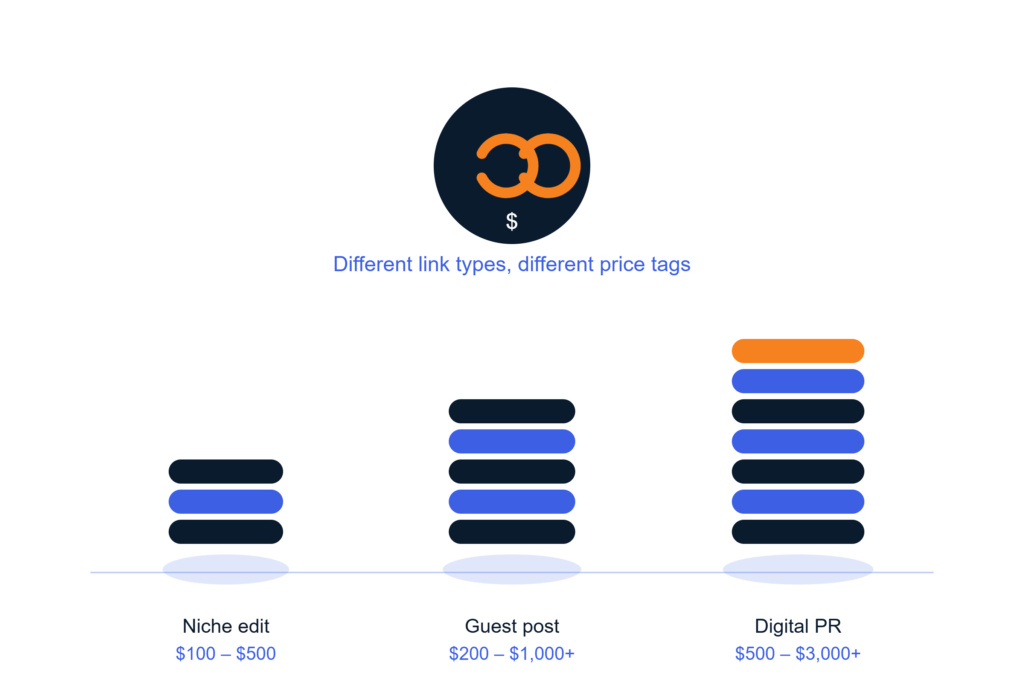
- Single backlink (average mid-authority site): $150–$600
- Niche edit / link insertion: $100–$500
- Guest post: $200–$1000+
- Digital PR / editorial placement: $500–$3000+
- Managed monthly campaign: $1500–$10000+ per month
These ranges hold across most general industries. Regulated or highly competitive niches (finance legal iGaming health) routinely run 30–100% above these numbers which we break down further below.
Why There’s No Single “Average” Backlink Price
Most pricing guides quote one average number and move on. That number is close to meaningless for budgeting purposes and here’s why: the backlink market isn’t a bell curve clustered around one price it’s split into two very different markets that happen to share a name.
The low end ($20–$150): bulk marketplace links PBN (private blog network) placements expired-domain redirects and links on sites with little to no real readership. These are fast and cheap because there’s no editorial process no relevance check and often no real audience behind the placement. Google’s spam-detection systems have gotten considerably better at identifying and discounting this category and increasingly AI search systems ignore these sources entirely when deciding what to cite.
The real market ($200–$800+): links placed manually on websites with actual organic traffic genuine editorial standards and topical relevance to your industry. This is where the labor prospecting outreach negotiation content vetting actually happens and where the price reflects real work rather than a database query.
Averaging these two markets together produces a number that describes neither of them accurately. When you’re budgeting the real question isn’t “what’s the average price” it’s “which market am I buying from.”
Backlink Pricing by Link Type
Different link-building methods require completely different amounts of work which is the single biggest driver of price.
| Link Type | Typical Cost (2026) | What You’re Actually Paying For |
| Niche edit / link insertion | $100–$500 | A link added into an existing already-published already-indexed article |
| Guest post | $200–$1000+ | A brand-new article written to the publisher’s standard with your link inside |
| Listicle / roundup inclusion | $300–$800 | A spot in a “best of” or comparison page that converts and gets cited by AI answers |
| Digital PR / editorial placement | $500–$3000+ | A link earned through a newsworthy story original data or expert commentary |
| HARO / journalist source links | No cash cost high time cost | A quote in exchange for a citation free in dollars expensive in hours and hit rate |
Why Niche Edits Cost Less
The heavy lifting writing the article getting it ranked building its own authority is already done. You’re paying purely for the placement and the publisher’s willingness to edit a link into existing content. This is the model behind our link insertion service the tradeoff is you have less control over exactly where and how the link appears and the fit has to make sense within content that wasn’t written with your brand in mind.
Why Guest Posts Cost More
You’re paying for two things bundled together: content creation and placement. A publisher expects a complete polished article that meets their editorial bar which is exactly what our guest posting service handles end to end either you’re writing it in-house or paying a writer who understands both the topic and the target site’s tone. This is exactly why a $150 “guest post” almost always means AI-generated filler on a site with no real readership; genuine guest post placements on sites people actually read simply cost more to produce.
Why Digital PR Sits at the Top
Digital PR links are earned not bought outright but the campaigns behind them (original research data studies expert commentary journalist pitching) require significant upfront investment. What you get in return is access to publications that no marketplace could ever sell you a placement on directly plus brand mentions and citation value that increasingly feed into AI search answers.
Backlink Pricing by Domain Authority Tier
Domain Rating (Ahrefs) or Domain Authority (Moz) is the metric most vendors price against and cost rises sharply as the number climbs.
| DR/DA Tier | Typical Cost Per Link | What This Tier Usually Means |
| 10–30 | $80–$250 | Newer or lower-authority sites fine for foundational supporting links |
| 30–50 | $150–$450 | The workhorse tier solid balance of relevance and cost |
| 50–70 | $300–$800 | Established sites with genuine authority and organic traffic |
| 70+ | $700–$2500+ | Major publications usually only reachable through digital PR or direct relationships |
The Problem With Pricing on DR Alone
DR measures exactly one thing: how strong a website’s own backlink profile is see how Domain Rating is calculated for the full mechanics. It says nothing about whether the site has real visitors ranks for anything or has any relevance to your niche and because it’s a calculable score it’s also gameable. It’s entirely possible to build backlinks to a site specifically to inflate its DR then sell placements on that same site even though it gets close to zero organic traffic.
The metric that actually predicts value is organic traffic not DR in isolation. A site with real visitors has by definition earned Google’s trust for something and a link from it inherits a piece of that trust. As a practical filter:
- DR 40 + 10000+ monthly organic visitors = a genuinely valuable placement
- DR 70 + close to zero organic traffic = a red flag wearing a good costume
If a vendor quotes you a DR number but won’t show you the host site’s organic traffic alongside it that’s worth asking about directly before you pay.
Monthly Link Building Budgets: What You Actually Get
Per-link pricing matters for one-off purchases but consistent ranking growth comes from sustained link velocity which is why most serious campaigns run on a monthly retainer rather than piecemeal orders.
| Monthly Budget | Typical Links Delivered | Best Fit For |
| $1000–$2000 | 5–8 contextual links DR 30+ | New sites single-location businesses testing the waters |
| $2000–$4000 | 8–15 contextual links DR 30+ | Growing sites ready to build consistent momentum |
| $4000–$7000 | 15–25 links DR 30+ includes competitor gap analysis | Competitive niches needing volume plus strategy |
| $7000–$10000+ | 25–50+ editorial links DR 35+ with traffic minimums | Established brands enterprise SEO teams agencies managing multiple clients |
Budget sizing isn’t really about company size it’s about how competitive your niche is and how fast you need to move. A local service business in a low-competition market can make real progress on $1000–$2000/month. A SaaS company competing against venture-funded rivals for the same commercial keywords may need $5000+ just to keep pace.
What Actually Makes a Backlink Expensive? Seven Real Factors
Two links can both be labeled “DR 50 guest posts” and be priced $200 apart from $800. The difference comes down to these factors:
- The host site’s real organic traffic. The single strongest price driver a site pulling real monthly visitors has earned trust that’s much harder to fake than a DR score.
- Niche and industry. Finance legal health and iGaming sit at the top of the pricing scale because publishers in these spaces know the content carries regulatory or editorial risk and price that risk in.
- Whether content creation is included. A niche edit needs no new writing; a guest post needs a full article built to the publisher’s standard that labor shows up directly in the price.
- Editorial standards and vetting. Sites that actually review submissions for relevance and quality cost more than sites that will publish nearly anything for a fee and counterintuitively the harder a site is to get published on the more the resulting link tends to be worth.
- Placement and anchor control. A link the publisher drops wherever they like is cheaper than one placed in a specific paragraph with anchor text you chose control costs money.
- Outreach labor. Every manually-earned placement represents real human hours: prospecting pitching negotiating and following up. This labor is priced into managed campaigns not padding.
- AI and LLM citation value. A newer factor: pages that AI search systems and chatbots pull from when generating answers authoritative guides comparison pages “best of” roundups are starting to carry a pricing premium beyond traditional SEO value since a mention there buys visibility in a channel most competitors aren’t tracking yet.
Buying vs. Earning Backlinks: The Real Cost Comparison
There are three fundamentally different ways to acquire a link and comparing their sticker prices alone is misleading the “cheapest” option on paper is often the most expensive once you count the full picture.
| Method | Real Cost Per Link | What You’re Actually Paying With |
| In-house outreach | $800–$2000+ | Salaries tools content production and a low reply-to-placement success rate |
| Marketplace / reseller purchase | $50–$400 | Cash plus the quality-control risk of unvetted inventory |
| Managed agency (vetted placements) | $150–$600 | Cash with vetting and failure risk absorbed by the vendor |
Running outreach fully in-house looks free because there’s no invoice for a “link purchase” but once you add a content writer’s time an outreach specialist’s time SEO tool subscriptions and a realistic 5–10% reply-to-placement rate the fully-loaded cost per successful link is usually the highest of the three options it only makes financial sense at real scale where a dedicated team stays consistently busy. If you’re an agency hitting this exact wall outsourcing to a white-label link building partner is often the more cost-effective route than scaling an internal team from zero.
Marketplace purchases are cheap and fast but you’re buying unvetted inventory with no visibility into whether the site has real readers or a gamed authority score.
A managed agency working with vetted real-traffic publishers sits in the middle: you get quality control without carrying the fixed overhead of an in-house team and ideally you only pay for links that are already live and have passed a real vetting standard.
Backlink Costs by Industry
Not every industry pays the same rate for a comparable link because publisher restrictions compliance sensitivity and competition vary sharply.
| Industry | Typical Pricing Level |
| iGaming / Casino / Betting | Very high |
| Finance / Fintech | Very high |
| Legal | High |
| Health / Wellness | High |
| SaaS / B2B Tech | High |
| Ecommerce | Moderate |
| Local Business | Lower |
| Lifestyle / General | Lower |
Regulated and high-scrutiny niches pay more because fewer publishers are willing to accept content in these spaces at all which limits available inventory and raises the price of whatever supply exists.
Red Flags: When a “Good Price” Is Actually a Bad Deal
A cheap price is only a bargain if the link is real and links acquired purely to manipulate rankings fall under Google’s link spam policies regardless of price paid. Watch for these signals before paying for any placement:
- The vendor won’t name the destination site upfront. This usually means they’re buying the placement from someone else after you’ve already paid you’re paying a markup for a middleman you can’t see.
- A DR score with no traffic data offered alongside it. As covered above DR without organic traffic tells you almost nothing about real value.
- Turnaround promises that don’t match the claimed authority. A genuine DR 50+ placement with real editorial review rarely goes live in 48 hours fast turnaround at that tier usually means low or no editorial standards.
- No replacement policy if the link gets removed or de-indexed. Reputable vendors with real publisher relationships stand behind placements; resellers reselling marketplace inventory usually can’t.
Frequently Asked Questions
1. What is a reasonable price to pay for one quality backlink in 2026? For a genuinely vetted placement on a site with real organic traffic and topical relevance expect somewhere between $150 and $600 for most industries with regulated or highly competitive niches running higher. Anything consistently under $100 is almost always coming from the low-quality end of the market.
2. Are niche edits cheaper than guest posts? Yes generally. Niche edits typically run $100–$500 because no content creation is involved while guest posts run $200–$1000+ because you’re paying for both a written article and the placement itself.
3. Why do two backlinks with the same Domain Rating cost such different amounts? DR alone doesn’t measure organic traffic topical relevance editorial standards or anchor control all of which independently affect price. Two “DR 50” sites can have wildly different real value if one has genuine visitors and strict editorial review and the other has neither.
4. Is it cheaper to build backlinks in-house or hire an agency? It depends on volume. At low volume in-house outreach is usually more expensive per successful link once you factor in salaries tools and a realistic reply rate. At high sustained volume an in-house team can become cost-competitive since the fixed costs are spread across more placements.
5. What’s a reasonable monthly link building budget for a small business? Most small businesses in low-to-moderate competition niches see meaningful movement starting around $1000–$2500/month. Highly competitive or regulated industries (finance legal SaaS iGaming) often need $5000+/month just to keep pace with better-funded competitors.
6. Do backlinks still matter with AI search and Google AI Overviews in 2026? Yes. Editorial citations brand mentions and authority signals continue to influence which sources both traditional rankings and AI-generated answers pull from and cite if anything genuine editorial trust has become more valuable as AI-generated spam content has made low-quality links easier for both Google and AI systems to filter out.
Not sure what a realistic budget looks like for your specific site and niche? Get a custom link building quote and we’ll map out a plan based on where you’re starting from.
