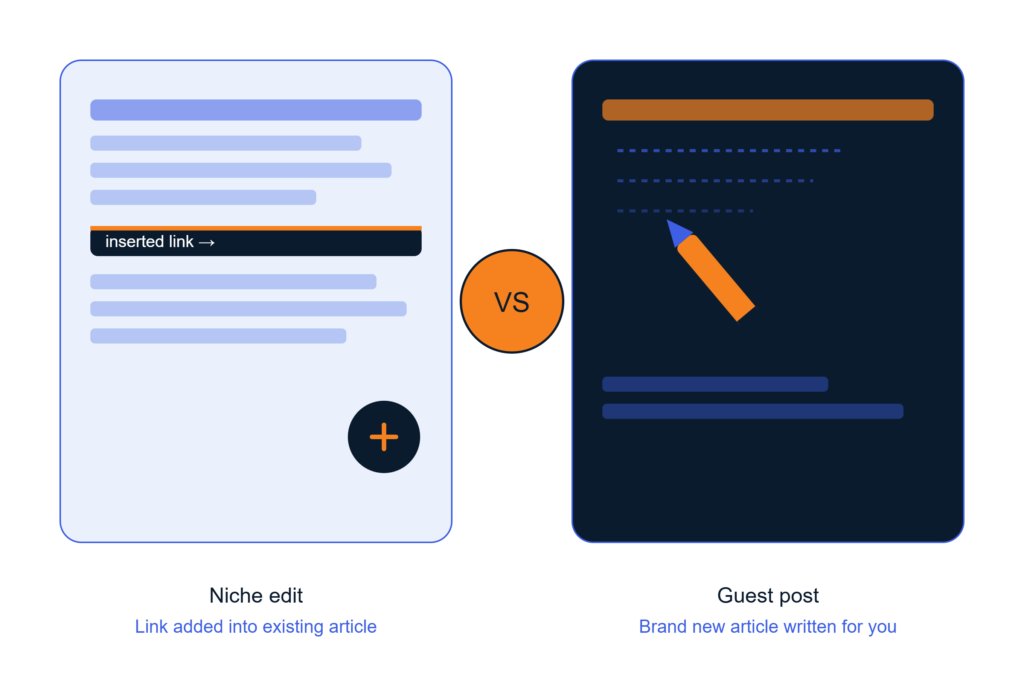
If you’ve spent any time researching link building strategy you’ve hit the same fork in the road every SEO eventually reaches: should you pay for a niche edit (a link inserted into an already-published article) or invest in a guest post (a brand-new article written and placed specifically for you)?
Most agencies answer this question with a one-liner “guest posts are safer” or “niche edits are faster” and leave it there. That’s not good enough for anyone actually spending a budget on this in 2026. The honest answer is that neither method “wins” universally. Each solves a different problem, carries a different risk profile, and fits a different stage of a link building campaign. This guide breaks down exactly how the two compare on cost, speed, authority transfer, risk, and long-term value, so you can decide which one deserves your next dollar.
Quick Answer
- Niche edits win on speed, cost-efficiency, and getting a link onto a page that already has aged authority and indexed history.
- Guest posts win on contextual control, brand storytelling, editorial relationships, and long-term risk reduction.
- The strongest link building strategies in 2026 use both niche edits for velocity and cost control, guest posts for authority-building and relationship capital rather than picking one exclusively.
What Is a Niche Edit?
A niche edit (also called a “curated link” or “link insertion”) is a backlink added into an existing, already-published article on a relevant website. Instead of writing new content, you (or your agency) find a live page that already ranks or has topical relevance, and negotiate with the site owner to insert a sentence or paragraph containing your link into that page’s existing body.
Because the host page is already indexed, already has backlinks pointing to it, and already carries whatever topical authority Google has assigned it, a niche edit can pass value almost immediately there’s no waiting period for a brand-new page to get crawled, trusted, and ranked before the link inside it starts counting.
How Niche Edits Typically Work
- A prospecting team identifies live, relevant articles on topically-aligned websites often ones already ranking for keywords near your niche.
- The site owner or their outreach contact is paid (or bartered with) to insert a link, usually within a sentence that’s added or lightly edited into the existing text.
- The link goes live within days, sometimes hours, since no new content needs to be drafted, reviewed, or published.
Why Niche Edits Are Attractive
- Speed. There’s no content brief, no writer queue, no editorial review cycle. A niche edit can go live the same week you request it.
- Cost efficiency. Because there’s no writing involved, niche edits are almost always cheaper per link than a guest post on a comparable domain.
- Inherited authority. The link sits inside a page that Google has already crawled repeatedly, which can mean faster indexing and faster authority pass-through for your target page.
- Lower content overhead for your team. You’re not producing 1,000+ words of original content for every single link useful when you’re scaling volume across dozens of domains per month.
The Real Risks of Niche Edits
Neither of the two articles we referenced above actually breaks down niche edits in any depth which is exactly the gap most link building content leaves unaddressed. Here’s what actually matters:
- Editorial fit can feel forced. Inserting a link into a paragraph that wasn’t written with your brand in mind sometimes reads awkwardly, and readers (and increasingly, AI content-quality systems) can tell.
- You’re relying on someone else’s page staying live. If the host page gets deleted, de-indexed, or the site changes ownership, your link disappears with zero warning.
- Quality varies wildly by vendor. Because niche edits are cheap and fast to produce at scale, this is where the majority of low-quality “link farms” operate. A site that sells 40 niche edits a month on unrelated pages is a very different asset than one that selectively places a handful on genuinely relevant, trafficked pages.
- Some hosts stack too many inserted links onto one page over time, which dilutes the page’s relevance and can look manipulative to anyone (or anything) auditing the page’s link history.
The practical takeaway: niche edits are only as good as the vetting behind them. A niche edit on a page with real organic traffic, a clean link profile, and genuine topical relevance to your industry is a strong asset. A niche edit dropped onto a random, traffic-starved page purely because it was cheap is close to worthless and can be a liability.
What Is a Guest Post?
A guest post is a brand-new article, written specifically for placement on a target website, with your link embedded naturally within content built around your brand’s expertise, product, or perspective This is the core of our guest posting service. Unlike a niche edit, you (or your agency) control the entire narrative the angle, the supporting data, the surrounding context, and exactly how your link is framed.
How Guest Posts Typically Work
- A relevant, ideally high-traffic site is identified and vetted for real audience engagement, not just a metric score.
- A pitch or topic idea is proposed to the site’s editor, tailored to what their audience actually wants to read.
- A full article is written ideally by someone who understands both the topic and the target site’s tone and submitted for editorial review.
- Once approved and published, the article lives permanently on the host site, with your link embedded in context you controlled from the first draft.
Why Guest Posts Are Attractive
- Full editorial control. You decide exactly what the surrounding content says, how the brand is framed, and where the anchor text sits nothing is retrofitted into someone else’s existing narrative.
- Stronger contextual relevance. Because the entire piece is built around your topic, the link sits in content that’s directly on-topic rather than adjacent to it.
- Relationship and brand equity. A guest post often opens a door to a real relationship with an editor or site owner one that can lead to more placements, co-marketing, or unlinked mentions down the line. A niche edit is usually a one-off transaction.
- Better for AEO and AI Overviews. As AI-driven search answers increasingly cite structured, well-reasoned articles as sources, a genuinely useful guest post has a better shot at being pulled into an AI Overview or cited by an LLM than a link buried inside someone else’s older post.
- Lower “manipulation” footprint. Because the content is new, original, and produced to genuinely inform the host site’s readers, it’s harder for anyone reviewing the site’s content strategy to flag it as purely transactional.
The Real Costs of Guest Posts
- Slower turnaround. Between pitching, writing, and editorial review, a guest post can take anywhere from a few days to several weeks to go live a real constraint if you’re working against a launch deadline.
- Higher per-link cost. You’re paying for content creation on top of placement, which is why guest posts typically cost more than a comparable niche edit on the same site.
- Editorial gatekeeping. Some sites reject pitches, request revisions, or demand the article meet a bar that a niche edit never has to clear which adds friction, especially at scale.
- Quality still depends entirely on vetting. A guest post on a site that publishes anything for a fee, with no real audience, provides almost none of the benefits listed above it just costs more to get the same weak result a bad niche edit would give you.
Niche Edits vs Guest Posts: Head-to-Head Comparison
| Factor | Niche Edits | Guest Posts |
| Speed to live | Days, sometimes hours | Days to several weeks |
| Cost per link | Generally lower | Generally higher |
| Content control | Limited you adapt to existing text | Full you write the narrative |
| Contextual relevance | Good if vetted well, forced if not | Naturally high, built around your topic |
| Authority transfer speed | Often faster (page is already indexed/trusted) | Slower initially (new page must be crawled and trusted) |
| Long-term durability | Depends on host keeping the page live and unedited | Generally more stable once published |
| Relationship building | Minimal usually transactional | Higher can lead to repeat placements |
| Best for | Scaling link volume, filling gaps quickly, budget efficiency | Building topical authority, brand storytelling, editorial relationships |
| Biggest risk | Vendor quality varies wildly; link can vanish anytime | Slower pipeline; higher upfront cost |
Which One Actually Wins in 2026?
Here’s the honest, non-generic answer: the method that wins depends on what stage of link building you’re in and what the link needs to accomplish.
- If you need to fill topical gaps quickly on a tight budget, or you’re supplementing an already-strong content strategy with supporting links, niche edits are the more efficient tool provided they’re placed on genuinely relevant, trafficked pages rather than bought in bulk from low-quality link farms.
- If you’re trying to establish long-term authority in a competitive niche, build editorial relationships that compound over time, or produce content designed to be picked up by AI Overviews and answer engines, guest posts are the stronger long-term investment.
- Search engines in 2026 are far better at reading context, traffic patterns, and editorial intent than they were even two years ago. Neither method is inherently “safe” a low-quality guest post on a content farm carries the same risk as a low-quality niche edit on an irrelevant page. The differentiator isn’t the method; it’s the vetting standard applied to the host site regardless of which format you choose.
The Blended Strategy Most Experienced SEOs Actually Use
Rather than treating this as an either/or decision, the most durable link building programs run both formats simultaneously, weighted by objective:
- Use guest posts to establish flagship placements on the most relevant, highest-traffic sites in your niche the ones worth the extra time and cost because they’ll pay off for years.
- Use niche edits to fill in supporting, contextually relevant links faster and more cost-effectively, especially on pages that are already ranking and driving real traffic.
- Vet every host site regardless of format for real organic traffic, topical relevance, and a clean backlink profile before committing budget.
- Track link retention over time for niche edits specifically, since these can be edited out or removed without warning in a way guest post placements rarely are.
- If you’re running this in-house and hitting capacity limits, outsourcing link building to a trusted partner is often more cost-effective than scaling an internal outreach team from scratch.
Frequently Asked Questions
1. Are niche edits considered a white-hat or grey-hat tactic? Niche edits sit in a grey area that depends entirely on execution. When placed naturally on genuinely relevant, trafficked pages with the site owner’s full knowledge and consent, they’re a legitimate, widely-used tactic. When bought in bulk from low-quality link networks with no relevance to your niche, they cross into the same territory flagged in Google’s own spam policies.
2. Do niche edits pass as much authority as a guest post? It depends on the host page, not the format itself see how Domain Rating is calculated for context on why this varies so much site to site. A niche edit on an aged, well-trafficked page with a clean backlink history can pass authority as fast as, or faster than, a newly published guest post that Google hasn’t fully indexed and trusted yet. A niche edit on a weak, low-traffic page passes very little regardless.
3. Is it cheaper to build links with niche edits or guest posts? Niche edits are almost always cheaper per link because there’s no content production cost involved you’re paying purely for placement. Guest posts include the cost of researching, writing, and often revising a full article on top of the placement fee.
4. Can a niche edit get removed after it goes live? Yes, and this is one of the biggest practical risks. Since the link lives inside someone else’s existing content, the site owner can edit it out, redesign the page, or take the site down entirely at any point, with no notice to you. This is why tracking link retention over time matters more for niche edits than for guest posts.
5. Should a new website prioritize guest posts or niche edits first? Newer websites generally benefit more from a mix that leans toward guest posts early on, since the relationship-building and brand-storytelling value compounds over time and helps establish topical authority from scratch. Niche edits work well as a supporting tactic once a base of strong, relevant placements already exists.
6. How do I know if a niche edit or guest post site is actually worth the money? Check for real, verifiable organic traffic (not just a domain authority score), genuine topical relevance to your industry, a clean existing backlink profile, and evidence that the site publishes content people actually read active comments, social shares, or consistent publishing history are all good signs. Avoid any site whose primary visible business model is selling links.
